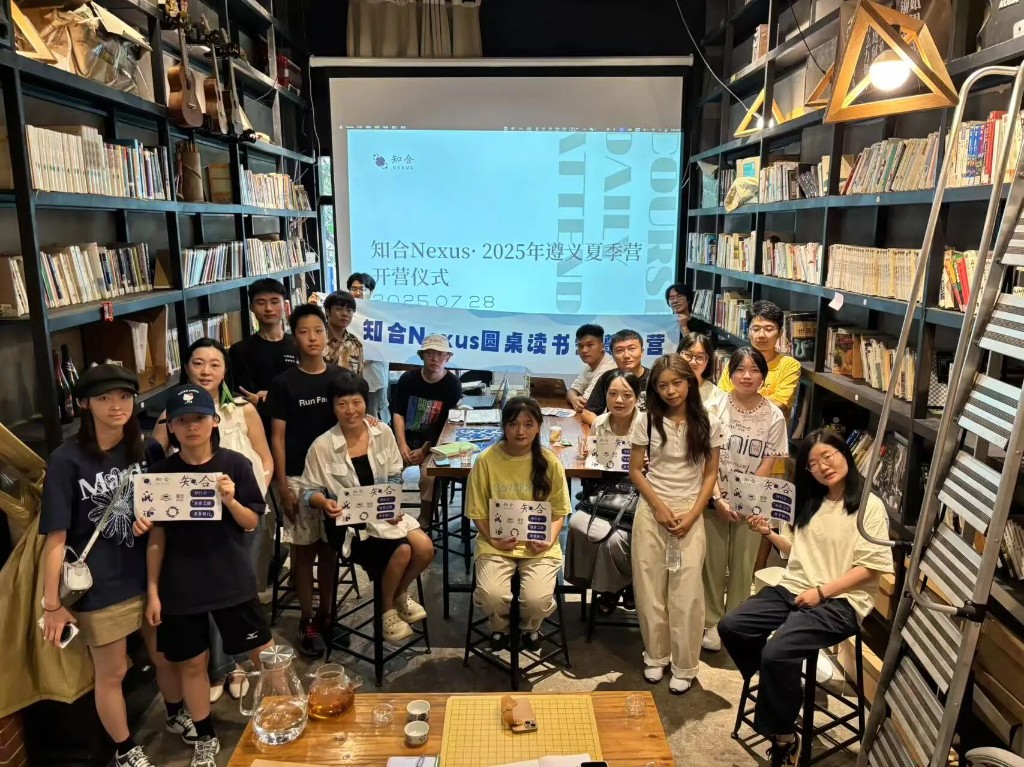
Two weeks is not excessively long, so from the very beginning I was planning "farewell." This was not only the hidden theme of my roundtable, but also a "farewell" that, for me, was quiet or barely noticeable. Because for me, "farewell" is the most dangerous moment, and a swift, silent escape is the safest plan.
So I also called it a night flight—like courtesans in ancient times who always married and left the brothel at night to shield themselves from gossip, as if moving between worlds were always shameful; like Hongfu fleeing to Tang, not knowing whether the road ahead was light or dark, yet knowing the past need not be clung to.
But this world would not allow me such arrogance. As I had hoped and deeply believed from the start, that inner, id-like expectation had already taken hold of my heart. Though I denied it at every moment—in an almost instinctive way—that this world held some utopia worth believing in, one that could pull back the desperate yet devout person lying face-down at the mouth of the pot.
When this "third world" descended upon me, everything became entirely different. Zhihe/Ledu and the co-readers did not respond to the invisible wall between me and others—they responded to me directly. "Just be yourself," or "I can feel the depth of your thinking…" When my course hinted at a messianic way of redeeming history, Zhihe/Ledu was so perfectly suited to that theme.
Ledu/Zhihe was truly built as a utopia. As Boss Xie said, "mutual trust is the only requirement." Language was no longer the tortuous thing of the secular world. Every wound, fantasy, and taboo could be spoken. And the courage to speak plainly—as Xiaoxuan demonstrated—is what draws us close to truth.
Co-reading exists as the expression of this form. The strength the co-readers gave me was an unexpected diversity and richness—a paradise beyond imagination. No theme went unanswered in a new way; no feeling went unretold in a new way. If the roundtable's theme was understanding human predicament, then their mutual understanding had already surpassed the roundtable's theme.
At this point, the night flight no longer showed its shame as an escape from shared living. Instead, as something that could be dissected into the tension of "farewell," it became a genuine exploration of history's hidden depths—collective/individual, present/future, optimism/pessimism… a revelation of human authenticity, truly understood within the entanglement of the small light Zhihe/Ledu granted and the roundtable's hidden theme.
If Zhihe/Ledu had already set a paradise as history's guide, smoothing over every latent grievance, then redemption arrived in the most sudden way. When the night flight had become reality, when "farewell" became—as it implied—the hidden thing of history inevitably blown away by the wind of time, the angel would look straight at the person whose inner world was about to become ruins. The angel's language brooks no refusal. I did not, and need not, hear Teacher Liao's final phone call clearly. Personality, age, interests, even beliefs—none needed to be considered. Every intermediary was unnecessary in paradise. All who were bound would break their chains; love itself became the theme.
In the end, whether to say "farewell" or not did not become the roundtable's hidden theme as I had seen it. In this journey, the presence of one another that this place could hold was made eternal. The night flight was no longer a secret rush toward the distant horizon—it was a bold rush toward this moment.
When shall we look again at the stars above—one by one, never extinguished.