
Nexus
Nexus is an educational innovation organization and a youth network. We are heading toward the cultural plains of this country—those vast stretches between peaks and basins, where countless young people are searching for paths.
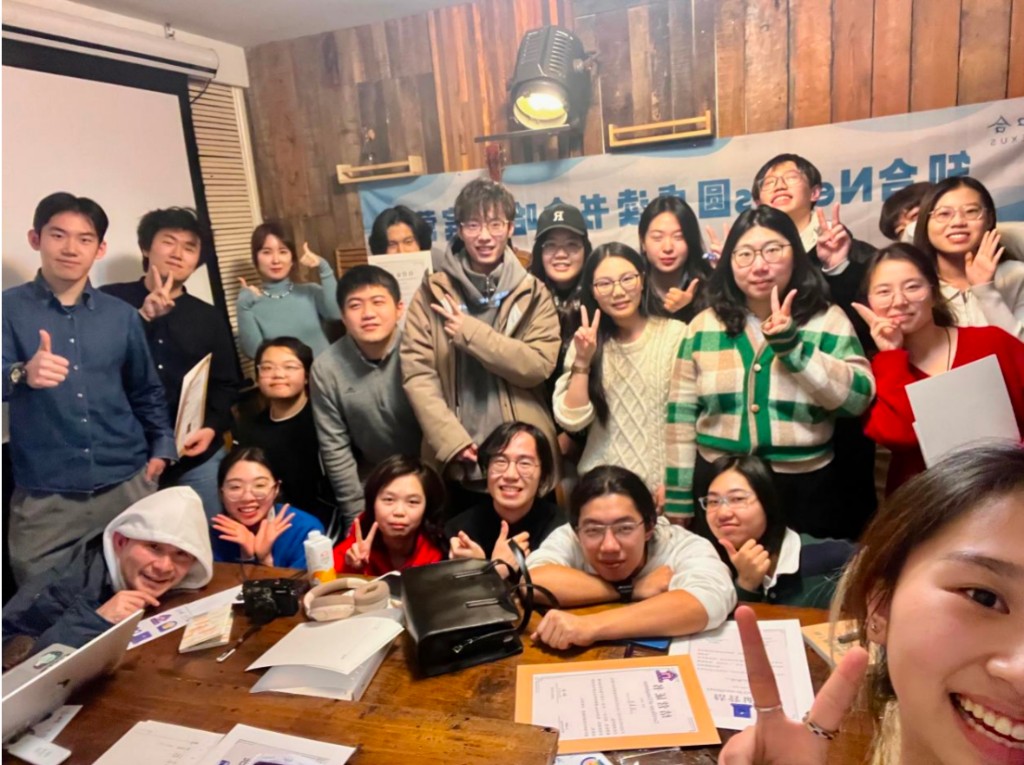
We will launch a new experiment, using the round table to connect two different yet similar groups—facilitators and co-readers.
We will also engage with countless local cultural and educational organizations, and together with people driven by curiosity—question, explore, and share.
Often, sitting at one corner of a round table improvised from a dozen ordinary desks, I simply watch them—speaking their minds in the northern afternoon sun, rereading the text, arguing with one another, and arriving at fresher, deeper understandings.
In many such afternoons past, I would sit where they sit now, facing a teacher I admired—timid at times, voluble at others—while they listened on with a smile, eyes full of encouragement or sympathy. Like the creator of a sandbox game, or the guardian of a magic circle, they kept the dangers of the real world at bay while letting everyone inside learn, understand, and reflect on how it works.
Years later, I finally sat on the other side of the table for the first time, carrying with me a similar gaze I had learned. And I finally understood—how much silence and tears it takes to earn eyes like that.
I saw you walking toward us
More than a month after camp ended, reading these lines from a companion at the Yuncheng camp still moves me deeply. From one side of the table, to the other side, to slowly becoming the table itself.
Wang Hanqian · Camp Notes | In the Dark of Night, All Things Grow Quietly Too
Before going to Harbin, I was full of doubt and anxiety, with a trace of anticipation and excitement—much like the first time I stood on this side of the table four years ago, yet so much was different. Before arriving, my friends and I had agreed in advance: we would hand the course back to the co-readers as much as possible. I had no idea where Harbin would take me.
Fortunately, once this overnight green-skinned train departed, it would not turn back. Over the more than ten hours from Beijing to Harbin, the cold crept in gradually: a thin frost on the window, chill seeping up from the floor, until at last I had no choice but to wrap myself in a thick blanket. Reclined in a seat locked at ninety degrees, my consciousness drifted into a haze—I hardly noticed when the train had already arrived.
Two companions from Harbin were already waiting at the station. Though I had never met Ma Chi or Jiudan before, amid the hurried crowds of the station, two long-haired men looking around made us easy to spot in each other. Because of all those invisible threads connecting us, we already felt familiar—like two old friends in the north.
Perhaps still dazed from the long journey, it felt as though we had already done so much in a blur—we picked up another facilitator, Jiangjiang, and went to a record shop. Ma Chi said it was one of Harbin's earliest record stores and livehouses; they had screened films here before. We came to collect a projector they had left here for the days of class ahead. Ma Chi and Jiudan also brought a calendar they had printed themselves as a gift to the shop—a reissue, it seemed, of an old calendar from years ago. Along the way, every place we passed, he and Jiudan could tell a little story. Looking out from the back seat, I kept thinking of boarding school days—taking the train home and finding my parents waiting at the station. In the quiet and the shifting cadence of stories, there is the steadiness of a road leading home.
As a wanderer drifting from place to place, returning to the "Wanderers' Parlor" truly felt like coming home.
This shop of barely forty square meters has witnessed Ma Chi and Jiudan, together with many of their "friends," creating countless moments. The space holds too many readable memories; perhaps every corner still bears traces left by wanderers who passed through.
The small shelves on the wall were filled with familiar publications: Oulipo, SDX Joint Publishing, The Chorus. There were also stickers brought from the south: Cizhi, Chen Dong Quan... In the space I spotted a set of books printed by a friend—The Big Dummy's Rebellion Handbook, Dinghaiqiao, David Graeber. Most of these books had to do with space; I imagined the two of them had discussed with many friends how to make a comfortable, easeful place.
I learned later that this was indeed the case. A circle of friends had lifted this space up together, then grown with it and let it branch outward—just as they had first gathered at Wenxin Coffee. In a city like Harbin, such "cultural spaces" are not many; sharing similar convictions and perseverance, people easily see and support one another.
I heard Teacher Ma say he had tried to bring this activity into schools, but met with many refusals. Then he turned and said, "It's all right—we still have many friends who can support us."
Co-reader
Unlike the Wanderers' Parlor, which had only just taken root in Harbin, Wenxin Coffee had already spent ten years here—from an early Heilongjiang University liberal-arts club to a cultural and youth space off campus. Wenxin felt like a magical field in Harbin, gathering young people who "enter through literature into the heart." The Wanderers' Parlor always gave me the feeling of a moving castle—as if tomorrow it might carry those materialized books, music, and films to another corner of the city. Wenxin, by contrast, was more like a wooden library that had already put down roots here, as though its foundation were an old tree. Perhaps that had something to do with Wenxin's abundant wood furnishings.
And Chao Ge behind the Wenxin bar seemed, throughout those few days, to keep his silent watch there—just as he had every day of those ten years.
Wenxin sits beside Heilongjiang University's campus, while the Wanderers' Parlor is near Harbin Institute of Technology—two small shops that seem to form a correspondence in time and space. During the reading camp, facilitators spent their days at Wenxin Coffee exchanging and sharing with co-readers; after evening activities, everyone would gather at the Wanderers' Parlor to drink, prepare lessons, and read. These two echoing presences seem to outline an indispensable part of Harbin's spiritual and cultural life. Perhaps because of them, Harbin holds a charm other cities can hardly match.
Hongyu, an old friend of Wenxin and the Wanderers' Parlor, "lent" his apartment to another facilitator of mine, while he himself, for those few days, moved onto the large balcony at Ma Chi's home—a unique space they had transformed, somewhere between a tatami mat and a bed, to shelter wandering "travelers" and friends coming and going.
To observe the traces of a person's life by being fully inside it is a singular experience. I saw the familiar camp certificate on the wall, a jersey on the sofa, hangers on the balcony and various seasonings scattered about—a brief illusion that I knew this person well. Before we actually talked, it was hard to guess that he worked a day job and spent his leisure time in a metal band.
Later, when I asked why he kept his hair long, he said it was part of his band's stage props. No wonder most people who see my long hair ask if I'm in music. At such moments I think: maybe I just forgot to get it cut.
At Nexus, when I stand on "this side of the table," it feels unlike any time before.
I am not someone skilled at leading or holding a room; my temperament makes me prefer listening and observing. Each time I stand on this side of the table, it costs me more energy, and so I fear anything beyond what I can anticipate. Perhaps this is the natural fear people feel toward the unknown—or perhaps "this side of the table" gives one an illusion of power, making you unwilling to truly hand the moment over to those across from you. Likewise, the feeling of being listened to and attended to can be intoxicating, making you believe this moment ought to belong to you, and must.
But as we agree and promise with every partner who comes to Nexus, we must return this space to the co-readers as much as possible—so they can step out of the role of student and become part of the round table. Though we do not have a table that is truly round, we must at least hold a round table in our hearts. I remind myself: this is not a stage for your academic ego or self-display; you are only a spark—the co-readers are the protagonists here.
This is not easy. Our discussion began with science fiction and gradually moved deeper into the texts; as it jumped from one text to another, co-readers and I seemed to treat each other as lifelines in the conversation—I hoped co-readers would speak more to the harder questions, while co-readers seemed to hope I would explain and interpret more.
Gradually, heads began to bow in the room. I could feel tension arising from different expectations: some hoped for deeper, more academic textual explanation; others hoped for simpler, more direct discussion. I was not prepared to face both expectations at once—perhaps I lacked the ability to fulfill both. Everyone remained too far from solarpunk, the Peach Blossom Spring, eutopia and utopia; though I tried to find real grounds for discussion, in texts and videos that felt somewhat hollow, they sounded more like empty echoes from afar. Frustration amplified like an echo.
This had much to do with mutual distrust and the strangeness of the first day. There seemed to be one simplest way to solve the problem: turn the discussion into a purely teacher-led, one-way classroom.
At that moment I understood how much courage it takes to return the power of discussion and voice to every individual.
The next day, a few small adjustments seemed to change how we discussed from then on: starting with a check-in question, I invited everyone to share something they had been paying attention to lately.
Other changes may also have been shifting the ecology: two people chose to leave. I felt, instead, a kind of relief. Or perhaps the arrival of two new figures completely changed the atmosphere at the round table.
"Lately I've been thinking about education issues among my classmates and in high school..."
"Lately I've been writing my thesis on the city..."
Everyone was connected in one way or another: some co-readers attended the same school; some came because they were interested in the urban themes in the reading group; some cared deeply about education. Such things are hard to learn from a brief self-introduction on the first day, and hard to achieve through one-way question-and-answer. It seemed that only by starting from a direct, simple question did we truly begin to know one another.
I realized I could invite Sean, who knows Marxism, to share his views on utopian socialism; I could invite Wang Fang to share her thoughts on urban planning; I could invite George to talk about hippies as she saw them. More importantly, everyone also began to notice the people beside them.
Before I knew it, I had moved to another seat—one that let me be both facilitator and co-reader. After all, there is no lectern here.
The theme of this reading group was "Practicing Utopia," inspired in title and content by Ou Ning's early course on iDEAL. What felt especially fortunate was that this course took place within a "utopia" that was actually happening—so no imagination seemed groundless, and every practice had somewhere to land.
The name "Nexus Peach Blossom Land" popped up on the third day of discussion, while we were designing our "ideal societies." Perhaps it recalled the Peach Blossom Spring from day one—China's most representative utopian imagination—or perhaps it was a direct description of the present moment. But even in the same room, after the same discussion, each person's Nexus Peach Blossom Land could be different.
"The utopia I imagine is right here in Harbin, at the Old Shipyard... There would be HR to select suitable participants... Income would come from business and external organizations... Some of this is already being practiced." Yiyao was one of the people who changed the whole discussion on the second day; she already seemed to have her own views and practices on "practicing utopia." More importantly, she was very good at "leading everyone in discussion." So when she led and sparked discussion, I quietly stepped back and let the conversation unfold fully.
"I imagine many clubs—film clubs, reading clubs, game clubs... Everyone works four hours a day, and spends the rest of the time discussing public affairs of the polis... Everyone here is my family and friends; there are no disputes." Sean was always the first to respond. He would think for a while, then offer his views. His "utopia" seemed strongly subjective, yet also carried shadows of history and books; discussion flared often.
"Our country is the most powerful monarchy in the world. There are two kinds of people—citizens and slaves... Property is held in common; we have the world's most advanced finance and technology, but only STEM is allowed to develop, not the humanities... Slaves handle all kinds of production work; some slaves are robots, some are immigrant laborers." George's vision sparked a great deal of discussion. Everyone laughed happily while constantly asking: "Where do the immigrants come from?" "What work do people do?" "What about other countries?" Life for citizens here seemed blissful, yet also suspended—suspended above vast amounts of basic labor and countless "slaves."
"Return to a state of multi-person wilderness survival—everyone manages themselves, educates themselves, with no fixed government or organizations... When hungry, you farm, forage, cook... Everyone is their own Robinson Crusoe." Ger also joined the round table on the second day; she always seemed to bring a different perspective. This vision leaned toward a return to the state of nature—perhaps beyond everyone's expectations.
I forget when, or who, first said, "We are in the Nexus Peach Blossom Land"—but in any case I wrote it on the blackboard. In this scene, it was indeed a kind of "practicing utopia": this place, these people, the things we were discussing—all seemed at a distance from reality. Perhaps cruelly, the utopias everyone imagined were completely different, even opposed to one another, yet here we were in the same room, seeming to share some consistent "consensus."
After listening, I felt moved in my own way. I wondered whether everyone had the courage to live normally in the utopias they imagined. At least for me, living in any of these utopias would take considerable courage.
Perhaps this also reminds each person: one person's utopia may be another person's hell.
After class I liked to walk in the afternoons. For several days I went from the Harbin Museum all the way to Central Street—a route that always passed a bridge crossing the railway. Later, discussing at the Wanderers' Parlor with Ma Chi, he pulled out several old maps of Harbin, and I recognized the bridge at once. I had not expected Harbin Railway Station to be right beside it; the bridge had been built precisely to cross those wide rail lines. It was the first time I had seen such a broad bridge spanning railway tracks—for some reason it always made me think of Chicago.
Each time I walked on that bridge, inspiration seemed to strike. It was here I thought of using check-in questions to help everyone "open up" more—I did not expect this to become a routine for the days that followed. One discussion would last an hour, and through it we came to know one another deeply, completely changing the atmosphere of the course. It was also here I thought of adding my personal perspective rather than descriptions from books—using Longomai and Tamera (two "communes" in France and Portugal) that I had actually visited and lived in, to bring everyone into that field together.
After all, compared with imagination, practice seems to require more courage. Most of the time our discussions still felt far from everyone: solarpunk, the Peach Blossom Spring, utopian socialism, Fourier, the garden city, the Summer of Love, intentional communities... One way to bring them closer is through concrete experience.
Meeting one unconventional person in the flesh can be far more moving than hearing that ten such people exist. Most criticism, misunderstanding, and abuse arise from lack of contact and communication—people imagine an Other and pass judgment from within themselves. Critique that remains after genuine contact and experience is the kind that has value and force.
When we watched Arcosanti together, different perspectives intervened and helped us see this "utopia" in Arizona anew.
"Everyone's curious—why is the English subtitle 'a state of fugue?'"
"Fugue is a musical form with two voices—two states of sound."
"Mm, so does it mean another way of living?"
"It's the young and the old—two directions."
"I see!"
Yes—the young people newly arrived at Arcosanti and the generation of Paolo Soleri, who designed the place, already held completely different ideas. The color of utopia had receded, yet the place remained—perhaps, as many criticized, feeling as though it were "drifting further away."
The day before the final session, I shared my wandering collection with everyone—a large box of assorted zines recording attempts to create and practice "utopia" in different places, like the Wanderers' Parlor and Wenxin Coffee. Everyone exclaimed "wow" in unison; after the exclamations, each began reading the parts that interested them.
I quietly stepped back again. Class was over; it was already lunchtime, yet no one wanted to leave. They stayed immersed in reading, and I seemed to see imagined attics taking shape in their eyes.
I felt more and more like an "itinerant peddler of ideas"—spreading out books and zines, enjoying the state of stall-side conversation. Talking with a vendor carries little pressure; and here, exchanging ideas, neither side loses anything, yet both gain something.
A friend said: "Like those little vendors at every stable in Zelda—you know they sell you things, but when they want the horned beetles in your pocket, they'll trade potions for them."
Yes, surely, I thought. When everyone teleports back to the hall, I'll be that NPC selling potions who appears on every map. "Young ones, did you lose this blue pill, or this red pill?"
On the last day, on the river, I walked alone for a long while. The Songhua freezes in winter; the ice holds for 180 days. Each spring, the ice may melt—but once melted, the river keeps flowing.