
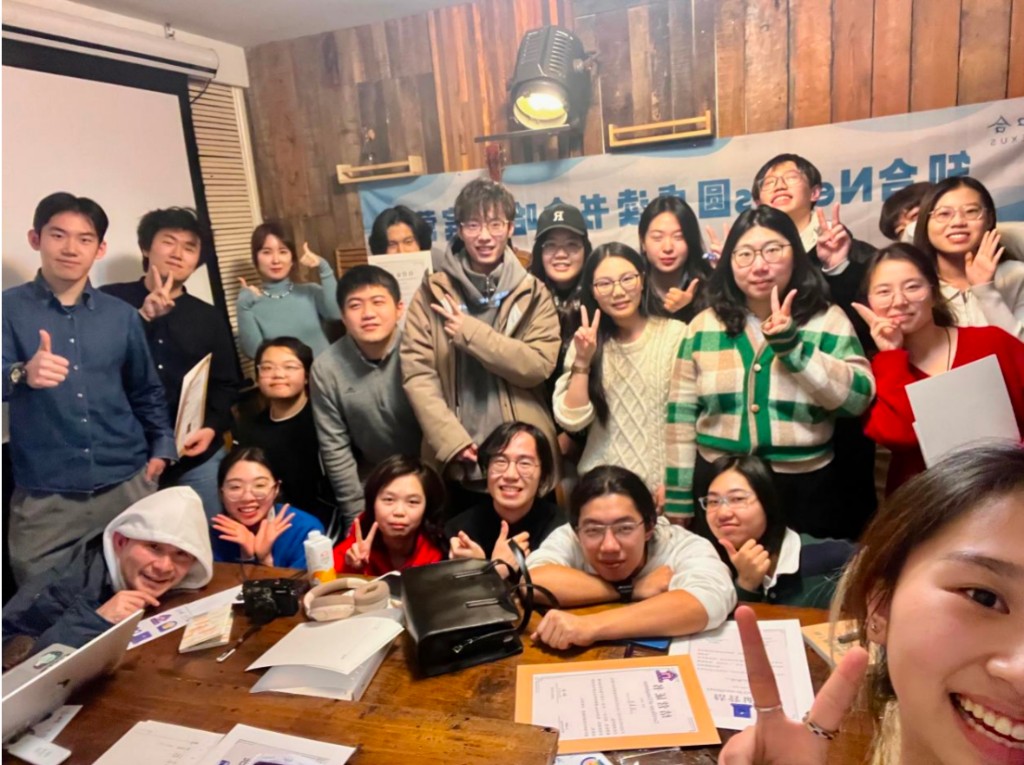
Nexus
Nexus is an educational innovation organization and also a youth network. We will walk toward the cultural plains of this country—those vast stretches between peaks and basins, where countless young people are searching for a path.
We are launching a new experiment, using the round table to connect two different yet similar groups—facilitators and co-readers.
We will also engage with countless local cultural and educational organizations, and together with people who carry a spirit of inquiry—question, explore, share.
On January 17, before landing at Yuncheng Salt Lake Airport, the plane I was on circled nearly a full loop, giving me a chance to look down on the place where I would stay for a week. First it passed over the towering mountains to the south, then threaded through a great lake in the gaps between the ranges—the terrain rising and falling, nothing like what I had seen all the way up from the south. As we drew near, the buildings along the streets grew larger: a string of yellow single-story houses, each hung with large signs in a single color… As the plane was about to touch down, I leaned my head back against the seat, closed my eyes, and felt my heart beating in time with the air outside.
Although several months had passed since I applied for this project, and I had revised the syllabus and gone through training, I knew there was still much I was not ready for. To make the round-table sessions easier and to leave something behind afterward, I had compiled the reading materials into a pamphlet—but time was tight, and the sample copy only arrived at my home the night before departure. The green on the cover was duller than I had imagined, and typos dotted the inner pages. After making last-minute adjustments, I had no choice but to contact the printer and have the materials shipped directly to Yuncheng. Now, the bag beneath me held only this sample copy, feeling almost too light, and I had not prepared any slides. As with every landing, I prayed for safety—but this time, when I closed my eyes, I also prayed for the days ahead.
Teachers from Nanfeng School came to pick us up. The school is in a new district near the airport, so the car did not head into the city center but sped along the main road. "Yuncheng International," the driver said. "We used to be called Yuncheng International School—a combined primary, middle, and high school with an international division, though most students still choose to pursue higher education in China." The car entered through a side gate, passed a broad athletic field with bleachers, then crossed a basketball court before reaching the dormitory. Three bunk beds, one large table divided into many compartments, and a bathroom with a shower—these would be shared by me and another facilitator for the week ahead, and felt remarkably spacious.
That evening, once all the facilitators had arrived, Nanfeng's teachers took us to a meeting room where we would discuss, prepare, and chat over the next few days. Before coming, I had received an elective roster. "There are no high schoolers because they haven't started winter break yet," the teachers told us. Faced with a co-reader group made up mostly of middle schoolers—no high schoolers, but including some university students and even graduate students—the first challenge was how to adjust the reading group's content and discussion format accordingly. This forced me to confront again why I had set out to run this series of reading groups. The theme I chose, "Reading Youth Literature Together," came from a simple feeling: literary works written by young people today are rarely read, and that does not mean they write "badly." After all, evaluating a literary work is never only about the text itself—it is also closely tied to the person reading it. By reading literary works written by peers together, perhaps a certain atmosphere could form. That is when literature shows its power.
There was also an urgency on the reader's side. The humanities books we read in daily life often teach lessons and emphasize knowledge, while many literary works move people through feeling and excel in sensibility. Yet in my own upbringing, courses and reading groups that valued the sensibility of literature were rare.
Would a reading group that speaks more of the pleasure of reading, more of emotion, and less of moral instruction easily become an outlet for feelings poured out at random? I think the difference lies in this: I hoped that through the reading group, everyone would strengthen a sustained attention toward literary works. Literature does not necessarily bring anything—because it operates on the principle of love. Authors regulate and integrate feeling through attention, and thus create literary works; reading literature likewise requires concentrated attention, reconstructing in the mind the moods and scenes of the work, before one can reach a strong emotional experience. This way of gaining feeling by investing great attention and imagination may be what is unique to literature. And attention, at its root, is a kind of love. At a time when attention allotted to reading—especially to literature—is growing ever more scattered, I wanted to gather more of this love through the form of a reading group. So I did not have many lessons I absolutely had to teach. If there was a goal, it was perhaps only to draw everyone's attention toward reading youth literature over these five days—and in the process of reading, drawing on everyone's feelings, good thinking might emerge.
This also seems connected to how I understand reading groups, or classrooms. To me they likewise mean a kind of attention—or a pouring forth of love—which may be the greatest difference between a reading group and reading alone. In a future where vast knowledge can be obtained through AI, we may still need classrooms perhaps only because they offer one another a space where love flows. Slowing the speed of feeling, lengthening the time of feeling, increasing the intensity of feeling—feelings formed in this way may more readily become a prelude that can withstand scrutiny and questioning.
So on the first day at the round table, facing nine middle schoolers, I divided young writer Chen Chuncheng's novel The Submarine in the Night into five parts for sequential reading and discussion: the protagonist's middle school years, high school years, university through early career, old age, and finally the outer nested structure as a whole. After each section I asked: What do you feel? How do you view the protagonist's actions or choices? What do you think will happen next in his life? Is this a true story or fiction—can you find evidence in the text? Because it was our first meeting, and in keeping with the theme of "slacking off in class," I also added a self-introduction at the start: please draw a symbol that represents you, then place it where you wish you could appear during class. Five minutes later, I sent everyone searching. Someone placed theirs on top of the blackboard; someone hid inside a cabinet or drawer; someone even said they had placed their name tag in the next classroom—and a crowd rushed down the hallway,
"Because this is my classroom. This is where I belong in the class."
she said
By the end of the first day, two students had transferred out of my round table and one had transferred in. One of those who left was the girl who had placed her name tag in the opposite classroom. When she learned she could switch classes, she was delighted: "Great! Teacher, I'm leaving!" And she left behind one remark: "Morning was literature, afternoon was also literature—how can they be so different! But I'm really just not interested…" So I followed her to the class she had joined, called out a few times, and drew one more student over. Now there were ten in the group: one university student, nine middle schoolers, and only one girl.
This was a scene I had never imagined. In reading groups I had run before, boys had never made up such a large proportion. Would they be too restless in their thinking, yet unable to immerse themselves in the text? Still, feedback from the first day was mostly positive. The student who transferred out said, "It was just like playing a murder-mystery game." That was the effect I wanted: making the format a little fun to help everyone read more carefully. This also avoided assigning reading tasks before and after each day's round table. After discussing The Submarine in the Night, we read an excerpt from an article on the educational reform of Beijing No. 4 High School Affiliated to Peking University, "The Best High School, the Last Reform." I had originally hoped students would connect the conflict between imagination and reality in the earlier novel with the tension between ideal and reality in the educational context, so they might gain a deeper understanding of themselves and the system they lived within. To my surprise, when I asked whether they would want to attend that school, Nanfeng's students shook their heads one after another. They did not want anything so extreme—two years of free exploration followed by a final year of hellish cramming:
Our school isn't like that. In seventh and eighth grade we still study for exams.
The creative writing classes at PKU Affiliated are great, but let's talk about that in college.
If it were me, I'd rather go to Hengshui. Compared with "going to college by day and high school by night," I'd rather go to high school by day and sleep at night.
Chen Touna (the protagonist of The Submarine in the Night) should go to PKU Affiliated—two years of play and one year of study. That's exactly his choice.
At a school like Nanfeng, which emphasizes quality-oriented education, these middle schoolers could already sense the burden that "quality" carries, had their own considerations for the future, and could draw connections between the two texts—all of which surprised me greatly. At the end of "The Best High School, the Last Reform," then-principal Wang Zheng is removed from office, and one of his former students writes,
"For Principal Wang, I would stand on my desk and cry out: O Captain, My Captain"
Reading this, a student asked, "What does 'O Captain, My Captain' mean here?" Someone remembered that in The Submarine in the Night, the protagonist also calls himself "Captain Chan" during an undersea expedition—but what was the connection between the two? At that point a boy pulled out his phone and began to read aloud: "'O Captain! My Captain!' is a poem by the American poet Walt Whitman, written in 1865 in mourning for President Lincoln. The poet compares America to a ship, Lincoln to the captain, and the struggle to preserve national unity and abolish slavery to a perilous voyage." Everyone suddenly understood. (Later we extended the discussion to the corresponding scene in Dead Poets Society.) After the reading group that day, I heard from other facilitators that teachers had already taught them to use Doubao—many students, when they encountered something they did not understand, would immediately ask AI.
Facing participants like these, I felt reassured on one hand and pressure on the other. Since they had few questions of their own, the facilitator had to take responsibility for maintaining the energy of the reading group. But on the second day, things took a turn. The theme was intimate relationships on campus. During the warm-up, I invited everyone to rate their school from 1 to 10 and explain why. After thinking it over, one student gave a low score like 3, while another gave nearly full marks. As they explained their reasons, the debate grew extremely heated. The student who scored low said, "There are cockroaches and bedbugs in the dorm," and "There are three cameras in the classroom—one point off for each." The student who scored high began to darken. Then the critic brought up how teachers did not seriously check reading assignments in class, allowing some to skate by. The high-scoring student was already angry: "That's because your class teacher doesn't check properly—it's an isolated problem!" The counterattack escalated to identity: "That's because you're a teacher's child!" A chorus of agreement followed. Then, under everyone's gaze, that student began to cry. I panicked for a moment and had everyone read the material and break into groups, while asking a friend who was observing to comfort him. The boy kept crying and would not join the discussion. As that section was about to wrap up, I added a few words on mutual respect and listening, then barely managed to transition to the main reading for the day.
Later my friend said that when she went to comfort him, though he was still shedding tears, she turned around and found he was not crying at all—he was secretly laughing. We shook our heads and said that sometimes students' pretense or malice really is trouble. But if handled well, it might also become an occasion for insight. In the latter half of that reading group, students reacted strongly to another detail. We were reading an "atypical campus romance" story. The protagonist and her boyfriend were not together because of good looks or grades, but because both of them "had long hovered near the bottom in appearance and academic performance." The title of the story, Pairing Off, comes from this passage: "Because we were ugly, we were really making do with each other. Our relationship was more like two inmates accidentally locked in the same cage, or like the palace maids and eunuchs who paired off in ancient courts." Teachers referred to them, and even they referred to each other, only by code names: No. 33 and No. 77. So-called dating amounted to holding hands and hugging. What the story described most often was the two of them sitting in the cafeteria, buying one newspaper together under the pretense of gathering material for essays, while 33 (the boy) read aloud to 77 (the girl). I asked students to divide into groups and write the characters from the story on the blackboard, using visual distance to reflect how close or far apart they understood the characters to be, then compare with one another. When we reached the relationship between 77 and her mother, we came to this passage (the backstory is that 77's mother discovered her husband might be having an affair; narrated in 77's voice):
She called me to her side and said, "Qiqi, if he doesn't want us anymore, I'll go out and earn money to support the two of us. Don't worry." I should have said of course I believe you, but I was terrified. When she worked as a river chief she couldn't even cover my expensive meals—let alone now. So my face showed exactly what I felt. She immediately hugged me and said sorry, then kissed my equally ugly lips with her ugly lips. In that moment I thought explaining my ugliness away as burns from a fire was idiotic. She had passed everything about herself on to me, and I had received my first kiss from her—and yet I was jealous of her, and believed she was jealous of me. I think I was truly wrong, because in fact we would never be jealous of each other.
One student read the opening of the passage and said that the mother did not call her daughter by name but also called her Qiqi, which showed their relationship was not close enough. I asked another student to read the rest—and then something unexpected happened. Nearly every student found the passage disgusting. I asked again, and they held the same view. "This mother is kind of weird." "Her mother is in heat." A mother kissing her daughter on the mouth—and "two ugly lips kissing is disgusting too." So I asked everyone to reread the earlier passage where the daughter believed they were jealous of each other, then look back: "What was the author trying to express by writing this?"
To express the mother's love for her daughter.
Love.
Then when the author wrote this passage, what attitude might they have had toward the kiss?
The author probably didn't think a mother kissing her daughter was disgusting.
I could have pushed further: Do we still find this description disgusting? If so, why? Why does ugliness make us feel disgust? Could there be other reactions? But I did not. At the time I thought that if I pressed on—into how family members express emotion, or how society judges and treats beauty and ugliness differently—some students' feelings might become too much to bear. Besides, I had no supplementary materials at hand. Yet everyone's feelings were undoubtedly valuable. It was precisely because emotional responses grounded in reading literature came first that students' ideas were stirred, and further questioning became possible.
After that reading group ended, according to the camp schedule we had to go upstairs immediately for an activity class. As the elevator doors opened, light slanted in through a row of windows in the lecture hall. In a northern winter, four-thirty was still merely afternoon—not yet dusk, closer to a little after three in the south at the same time of year. When signing up for time slots, I had volunteered for the afternoon, originally thinking that afterward I could watch the sunset with everyone. That plan backfired. The activity was called "Pen Cannot Stop": six facilitators served as team captains, students joined freely, and in each round of writing every member of a team had one minute to write—content could be anything, the only rule being that the pen could not stop. In other words, it encouraged improvisation, to see what kind of chain story would emerge. Unexpectedly, the students who chose my team were all familiar faces from the round table. The first student to put pen to paper immediately began rewriting the story of 33 and 77—in the novel it ends sadly, with 77 giving up 33 and letting him be with another girl who seemed a better match. After one round, it had somehow become a rather beautiful story. I did not say it aloud, but I was truly happy—because characters from the world of literature had also remained in my life in similar ways, and continued to exert their influence. Quietly, I also hoped the author of 33 and 77 could know all of this.
The round tables in the days that followed had their share of resonant moments too. When we talked about the ban on fireworks, students said Yuncheng had issued related regulations but did not enforce them very strictly.
What if a police officer or inspector tried to stop you from setting off firecrackers?
Then I'd set them off right in front of them!
Facing such innocent wildness, I had to emphasize again and again: if you were in a place with strict enforcement, you would get arrested for that! To set up the reading ahead, I also had to ask: if you lived in such a place and still wanted to set off firecrackers, what could you do?
Buy them and set them off secretly.
Speak out publicly!
Reading Wang Zhanhei's Empty Firecrackers, I asked everyone to consider the tension between social identity and personal identity by exploring the inner lives of various characters—a sanitation worker, a neighborhood committee auntie, and others—on the eve of the fireworks ban. At the end of the story, Uncle Xing, an elderly man with a limp in the community, takes a child who wants to set off firecrackers, gathers a hundred or so balloons, and climbs to the rooftop. As midnight approaches, the two of them pierce the balloons with a screwdriver:
Bang, bang—the sounds echoed across the river and drifted away. The burst balloon skins flew up, then fell back down, like hundreds of firecrackers spent and lying peacefully on the ground. The child shouted, pushed past the adults' legs, and rushed toward the balloons.
The students exclaimed in admiration. I then took out a set of traditional Chinese color cards I had prepared and asked everyone to choose a color to express their reading response. Some found it thrilling; others felt it still fell short. But everyone agreed: "The author is pretty clever." I also showed a short film adapted from the story, The Story of Firecrackers, so students could consider the differences between the two media—novel and film.
The novel has many rich characters; the film condensed them into a single main line and cut several people.
The novel can show characters' inner thoughts directly. I also really liked the ending of the short film where they pop the balloons—it felt more powerful and striking than the novel.
If everyone already had their own strong understanding, I did not need to say much more. Often, sitting at one corner of a round table temporarily assembled from a dozen ordinary desks, I simply watched them—in the northern afternoon light, speaking their ideas passionately, rereading the original text, arguing with one another, and arriving at newer, deeper understanding. In many such afternoons in the past, I had sat in their seats, facing teachers I admired, timid yet sometimes unable to stop talking, while they simply listened on with encouraging or sympathetic eyes. Like the creator of a sandbox game, or the guardian of a magical barrier, they kept the dangers of the real world outside while letting everyone inside learn, understand, and reflect on how it operates. Years passed, and for the first time I sat on the other side of the table, carrying with me a similar gaze learned from those I had watched. And I finally understood how much silence and tears it takes to earn such a gaze.
Every morning I prepared for the afternoon round table in the meeting room, sometimes with other facilitators who were there, ordering takeout called "Protect Your Porridge"—blowing on pumpkin porridge while flipping through thick stacks of materials. At noon when I went to the cafeteria, students from class would call me teacher. The organizers of the reading group often reminded us not to use "teacher" and "student," but more egalitarian terms like "facilitator" and "co-reader." I largely agreed that the former implied a hierarchy, and I had felt many times how students raised angles and formulations I had never considered. Still, in everyday speech, I was in no hurry to correct them.
Changing the words is meant to change the substance, I thought—so when the words still feel awkward, it is better to spend more energy on the substance itself.
Later round tables had difficult moments too. When discussing Guo Shuang's novel The Moon, I asked everyone to consider the tension within the character Liu Lili between her identities as "mother" and as "woman." One passage describes how the mother sometimes accidentally catches sight of her bedridden son's naked body:
A man's lower body had become unfamiliar to her. Her husband had not touched her in a long time. She originally had no reason to look at her son as one looks at a man. It was only that the changes of the past half year or more had come without warning. She doubted she could ever again be the kind of mother who had lost her gender, as before.
Naturally, no one could bear to look directly. So I had to ask everyone to consider the author's attitude—and face my own shame and confusion—trying hard to say that "sex is normal." When we came to those three years from 2020 to 2022, I gave everyone a mask and asked them to put it on, and that feeling all came back. In The Letter Never Sent, there is a scene of cursing at a neighbor. Students said watching it in Mandarin was not satisfying enough—they insisted I say "You blind bastard" in Shanghainese…
But there were always expansive moments too. Reading The Letter Never Sent, when we talked about indifference toward neighbors, everyone was confused at first—most had no experience of long-term life in a big city. But as the story progressed, we saw the neighbor entrust her dog to "me" before going into quarantine, then lock her door after returning, live on takeout, and eventually slip away secretly because she could not pay rent. "I" was also a tenant who had failed the graduate entrance exam and was about to move out, yet through a small hole in the wall between two rooms, I could sometimes secretly watch her beloved "Snoopy" and slowly begin to understand the feelings involved. In the end we read the story's closing in a chain, a confession left for the one who had departed, before "I" too had to leave:
I went upstairs. Next door the vacuum cleaner roared—a fully equipped cleaner was tidying the apartment. I walked in. She probably thought I was the landlord and did not stop me. I closed the door and crawled under the bed that had not yet been cleaned. The food thrown through the wall hole, and a few crumbs, still lay on the floor. I scraped them together with my fingers and pushed them back through the hole. Through the hole I saw my own room like a small boat with upturned ends, neatly holding my bed, my slippers, my electric fan, and those days when my hands and feet were repeatedly broken off inside the room.
Uncle, fortunately we can always grow new hands and feet. The moon outside the window is so large—nearly a perfect circle. With it as our wall hole, are you also secretly watching this world? Then we are looking at each other. Summer is almost over, yet the temperature shows no sign of falling. The earth is like a lit match; before it goes out, we will all be trapped in the great fire—except for you, who have reached the moon. Uncle, I saw you open the window and lean out. No one can make a decision ahead of time the way you can. Uncle, wherever you go, I will look toward you.
After a brief silence, a student said the author was truly great—to write so much for someone she barely knew. So I made a spur-of-the-moment suggestion: please draw, simply, a passage that left an impression. Projected on the screen, someone drew two adjacent rooms with broken hands and feet inside; someone drew the building opposite and trees in a rainy night; several students drew the moon—the moon in a window, the moon between buildings.
When it was over, I left the pamphlets with everyone and let each student choose one volume from Feng Junhe's X Bookstore: Twelve Fictional Chinese Classes, or a copy of Shanghai Literature containing several of the stories from our materials, along with Rilke's Letters to a Young Poet. I said these had been important references while I was preparing—they could take them home to read, but afterward please return them to the class book corner. In any case, let them keep circulating.
They gave me many things in return. Someone messaged me to say they had read many articles they had never encountered before and gained a new understanding of literature. The girl who had transferred in gave me a pear—small, with several black scars on its skin, but firm and slow to spoil. More than half a month later, it is still in my room, looking much as it did at first. At the closing ceremony I said I hoped everyone's lives would go smoothly from here—but if they did not, it would already be enough to recall what happened and what was read during these five days. I had little confidence saying something so weighty, but looking back, my greatest assurance came from all my co-readers: in afternoon classrooms, surrounded by games and short videos, works written by a group of young people still stubbornly seeped into hearts and memory—enough to convince me of the hope and meaning of literature and of connection with one another.
The day I left, a fine rain was falling. Early in the morning, after saying goodbye to my roommate at the dormitory door, I walked through the dark basketball court, across the athletic field, passed the cafeteria where we had eaten these past days from the side, and through the teaching building. The school gate was locked shut; a taxi was already waiting outside. I knocked several times on the guard room door—no answer. With only four days until the New Year, the school held almost no one but us facilitators. I had no choice but to use a skill I had newly learned from returning late these past few days: I tossed my luggage through a gap in the fence, climbed over the waist-high barrier, and dropped down on the other side. To say goodbye to Nanfeng this way made me happy too. Come to think of it, it was here that I learned to climb over a wall— as if making up for something I had missed in my youth. Being alone did not feel so frightening anymore, because I knew that in the dark, everything grows quietly too.