
16:00 — 21:00
Summit 2026
At the Nexus
在交汇处
Summit theme
At the crossroads of geography, relationships, and fields, new questions and ideas are always born.
For Zhihe, convergence is not only about human connection—it is an ongoing dialogue between ideas and action, place and world, personal growth and public care.
The 2026 Zhihe Summit takes "At the Nexus" as its theme, hoping to create an open and authentic space for exchange. We begin by returning to our community—to reflect on the year's explorations, share one another's growth, and imagine Zhihe's future together—then look outward, discussing public issues with scholars, practitioners, and young changemakers from different fields.
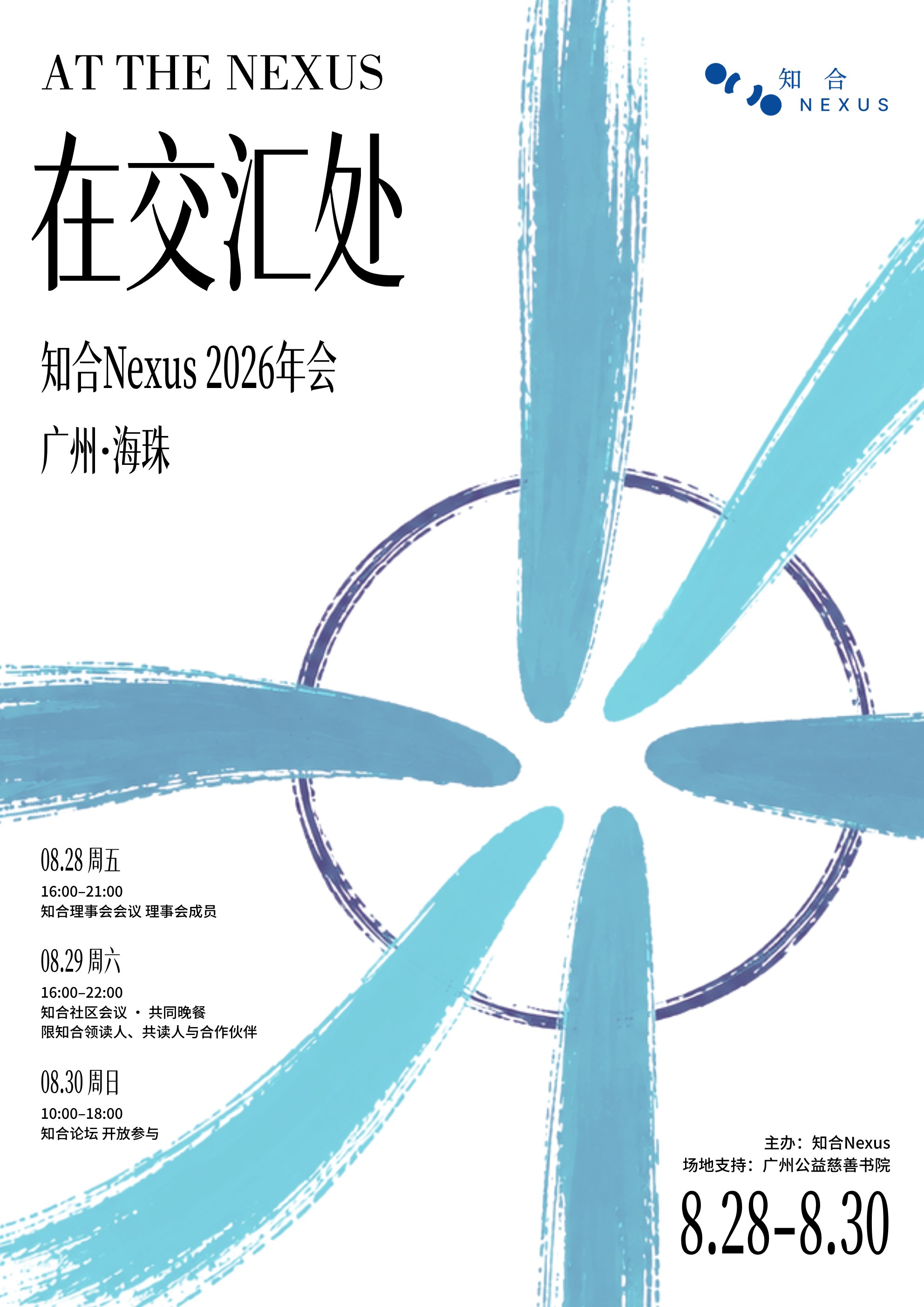
Day 1 · August 28
Board Meeting
Board members only
Day 2 · August 29
Community Meeting · Shared Dinner
For Zhihe facilitators, participants, and partners only
16:00 — 22:00
Community meeting
Core discussion topics:
- Zhihe's direction for the coming year
- Annual program planning
- City node development
- External partnerships
- Community operations
- Learning mechanisms
Day 3 · August 30
Zhihe Forum
Open to the public · At the Nexus · Four conversations
Morning
10:15 — 11:00
Below the soil, above the school: a first-generation college student's educational practice in the city
This talk follows a personal biography along the axis of education: schooling in the city, half a year at a township school in northwest China after college, and then research on China's "double reduction," the gaokao, and first-generation college students at a leading education school. Along the way, "structure and agency" has been academic training, field observation, and self-reflection—an invitation to explore one possibility of self-education in our time.
- Xiao Jijun — M.A. Sociology of Education, University College London (UCL)
Panel
11:00 — 12:30
Is Zhihe an educational organization? Reflections from three teachers
At Zhihe Nexus we imagine what education could be. This conversation brings together three teachers who have served as organizers or facilitators at Zhihe while also teaching in public and private schools at home and abroad. Through their practice, we will discuss ideals of education, Zhihe's model, and how roundtable reading might take root in schools.
- Feng Xiaoxuan — Chinese teacher, private school in Zhongshan
- Yuxin — Chinese teacher, Singapore government school
- Shui Liang — Gaokao training teacher, tutoring institutions in Tianjin & Henan
Lunch
12:30 — 14:00
Free conversation
Afternoon
14:00 — 15:00
Teahouses, taverns, and the jianghu: how women and migrants cultivate space and community
Starting from a community teahouse by a river on the Chengdu Plain and a tavern in Gyirong, Shigatse, this talk looks at how everyday encounters forge spaces of trust and mutual care—and how, at a China–Nepal border town, people and things from different nations, ethnicities, and backgrounds reshape the meaning of borders and territory.
- Yi Liangjing — China Women's University · Social Work
- Liu Baichuan — PhD candidate, Royal Holloway
15:30 — 17:00
Community and the public—experiences in education, arts, and the humanities
Community is often seen as bounded, and by an earlier generation of activists as "small-scale" and lacking influence. Today, participating in public life through community seems to have become a shared pattern. Can different forms of community open a path from the individual to the public?
- Zijin — Former steward of Rengshitou
- Atong — Representative of Didan Society
- Lizhi — Gatekeeper, Zhihe Nexus
Join
Registration
Single session
¥15 / person
Admission to any one session
Four-session pass
¥40 / person
All four sessions plus a Zhihe souvenir
Free for past Zhihe facilitators, participants, and other volunteers (show the relevant group chat); free for MPS alumni.
Venue: Guangzhou Academy of Charity
Founded in June 2014, the Guangzhou Academy of Charity is China's first academy dedicated to philanthropy education and cultural research, jointly initiated by the Guangzhou Charity Association, the Qianhe Community Foundation, and the former SYSU Institute for Philanthropy. Guided by values of self-reliance, humility, pragmatism, purity, and gratitude, it focuses on talent development, foundational research, and cultural work in the philanthropy sector.